Pythia · Document intelligence
Read every file. Find what matters. In hours, not days.
Juniors spend days reading. Partners wait. The thing you miss is the thing that loses the case. Pythia reads everything - every file, every footnote - and lets you ask questions the way you'd brief a junior.
It runs on your hardware. Nothing leaves your office. No cloud, no third-party APIs, no exposure.
On-premise · Private · 30 minutes
How it works
A self-hosted document intelligence platform for document-heavy work.
Pythia processes entire disclosure sets locally: semantic search, conversational Q&A with citations, interactive timelines, and OCR. It finds every relevant file, and shows you exactly why it surfaced.
Ask in plain language
Semantic search · Cited answers
Ask it the way you'd brief a junior. Every answer cites the source document and page number. No guessing, and no answer drawn from the model's own knowledge rather than your files.
Nothing leaves the office
On-premise · Zero cloud APIs
OCR, inference, vector search and storage all run locally on your hardware. No data is sent to third parties. Legal Professional Privilege is satisfied by architecture, not by policy.
Every document, every format
150,000+ files · All formats
PDF, DOCX, MSG, EML, XLSX, TIF and more. Pythia reads in your first disclosure set in a few weeks, and new documents are added as they arrive.
What it looks like in use
3 days → 3 hours
Document review per matter
Zero
Files that leave your office
Every footnote
Found, cited and explained
Find all documents referencing the March 2023 board meeting and summarise the key decisions.
Found 14 relevant passages across 6 documents. Key decisions: approval of revised share structure (Exhibit C-112), appointment of interim CFO (Email D-0447), deferral of acquisition vote to Q3 2023 (Board Minutes C-089).
Show me all emails between the claimant and defendant between January and April 2022.
Retrieved 38 emails. Earliest: 4 Jan 2022 (REF: D-0012). Latest: 29 Apr 2022 (REF: D-0891). 12 marked confidential by producing side.
Build a timeline of contractual deadlines mentioned across all documents.
Extracted 23 deadline references. Key dates: 15 Feb 2022 (payment milestone, Contract §4.2), 1 Jun 2022 (option expiry, Addendum B), 30 Sep 2022 (longstop date, original SPA).
The system
Running on a client's own hardware.
Screens from a live deployment. Names and identifying detail are not shown.
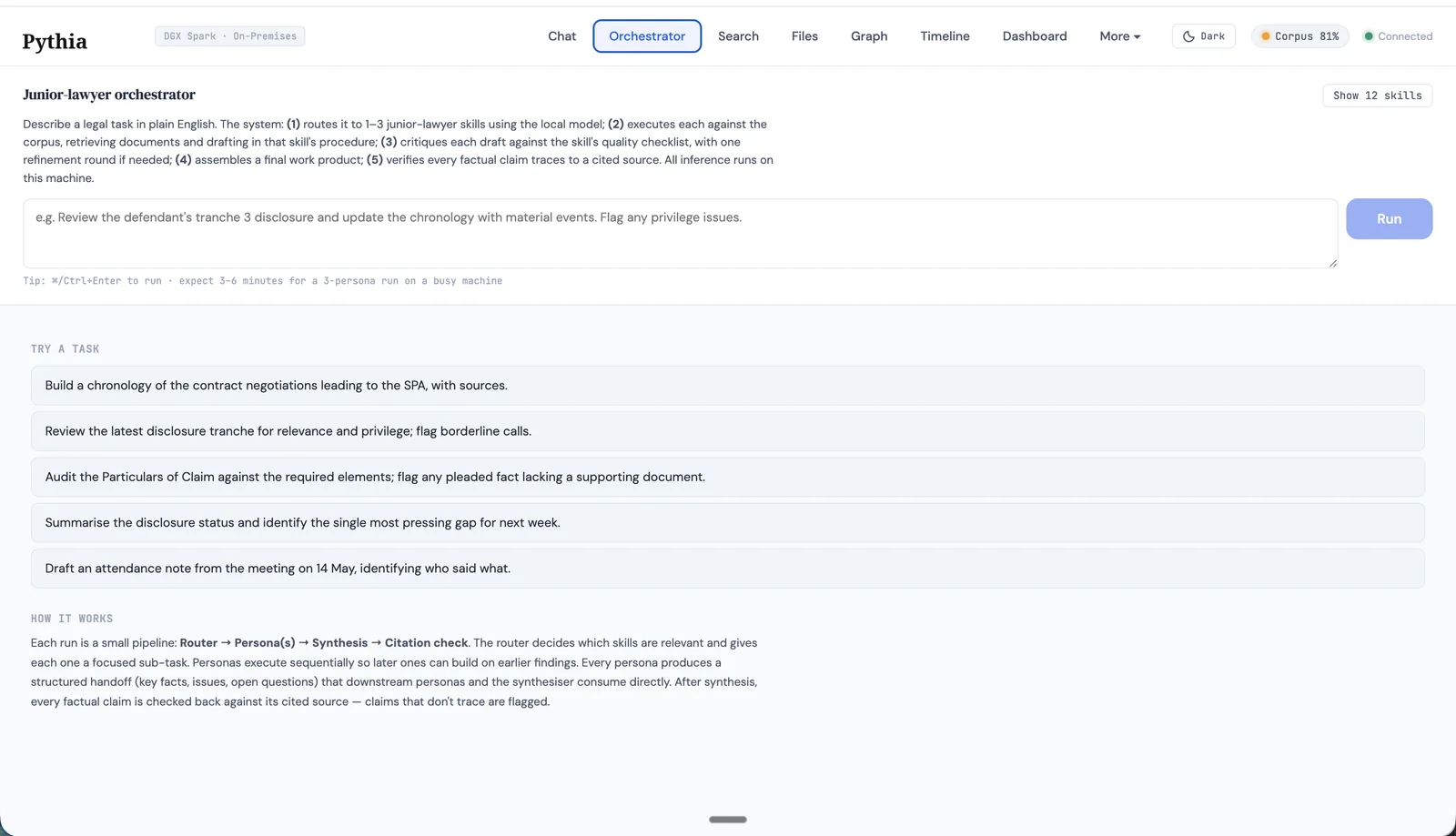
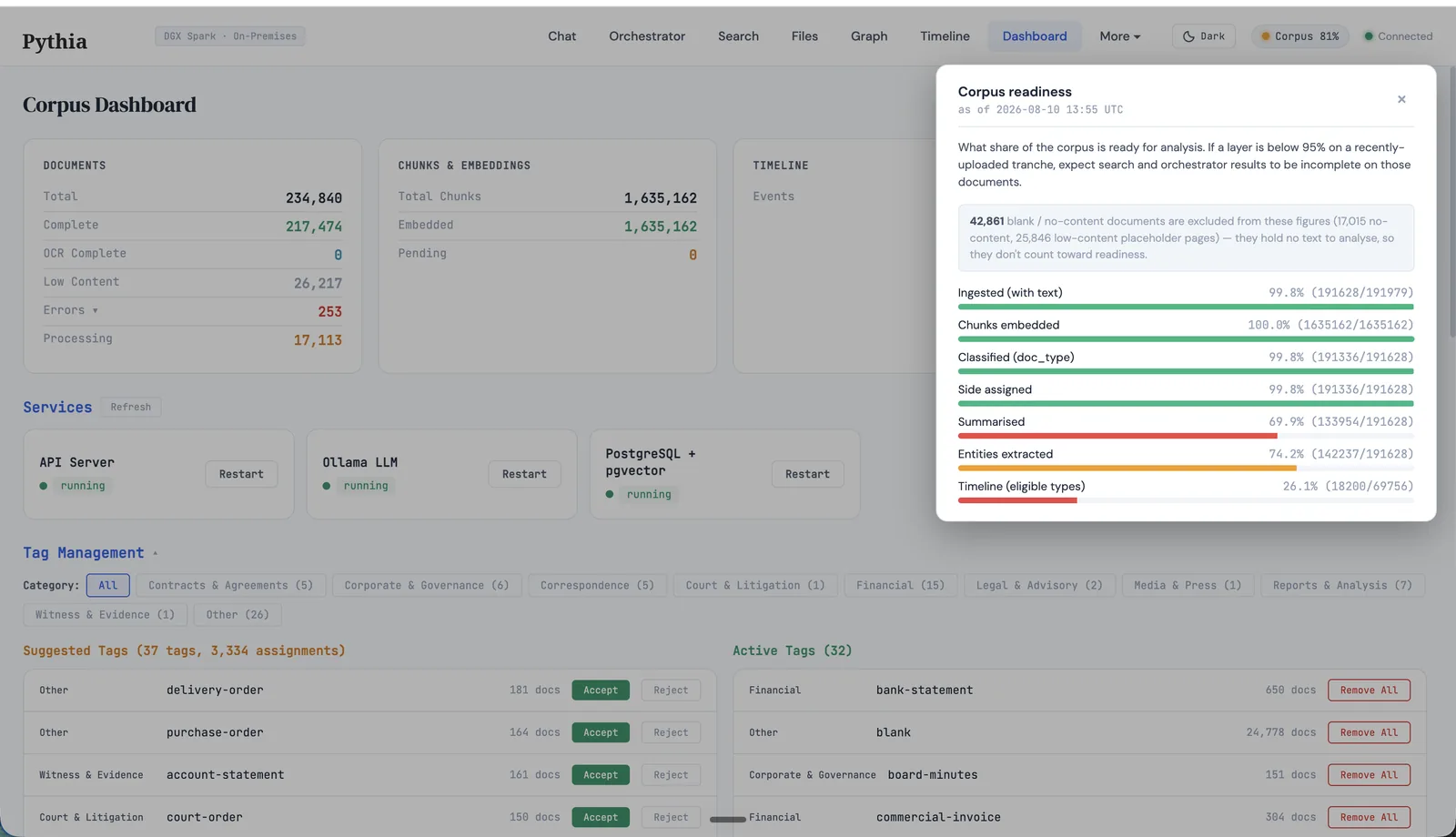
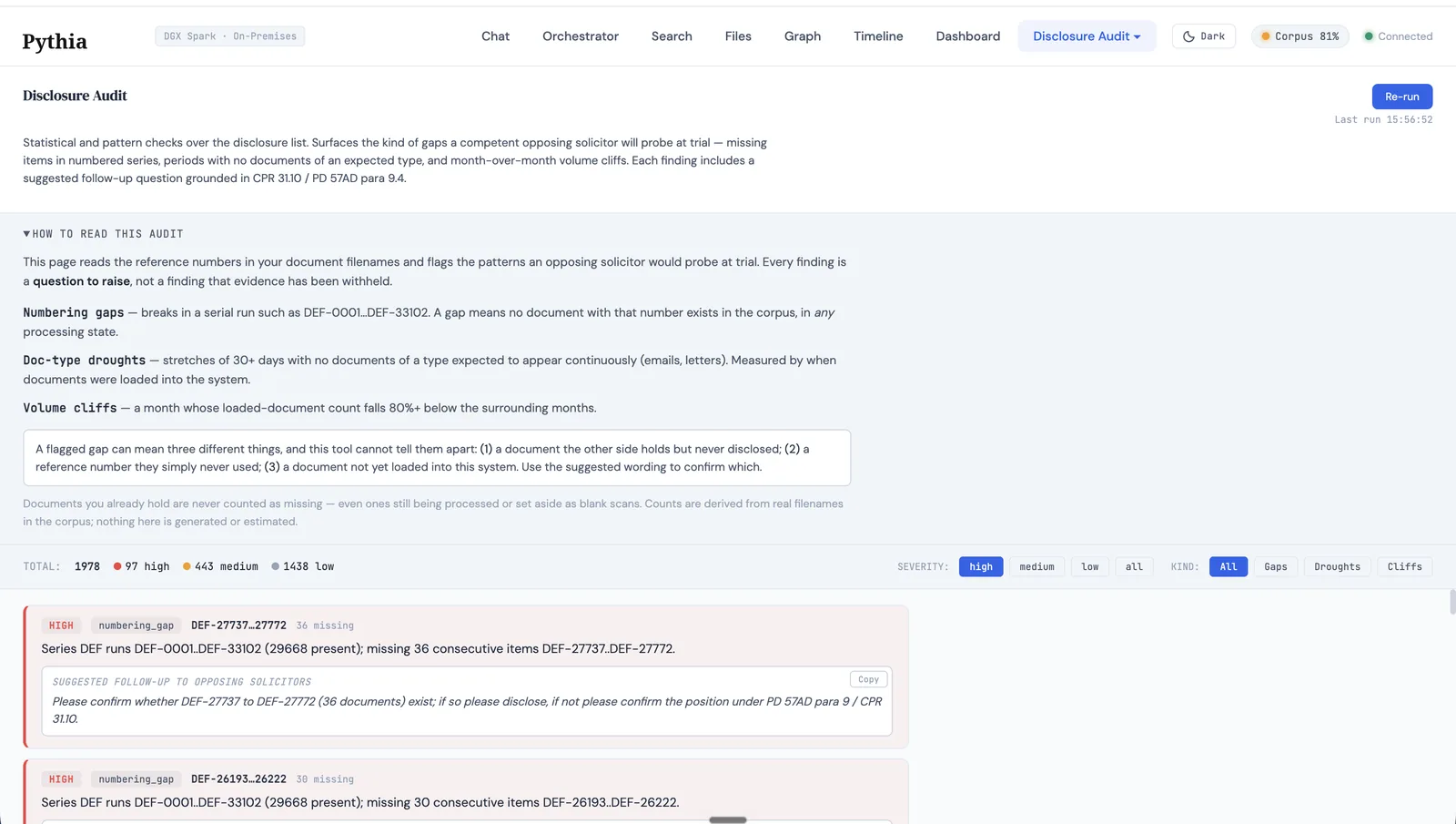
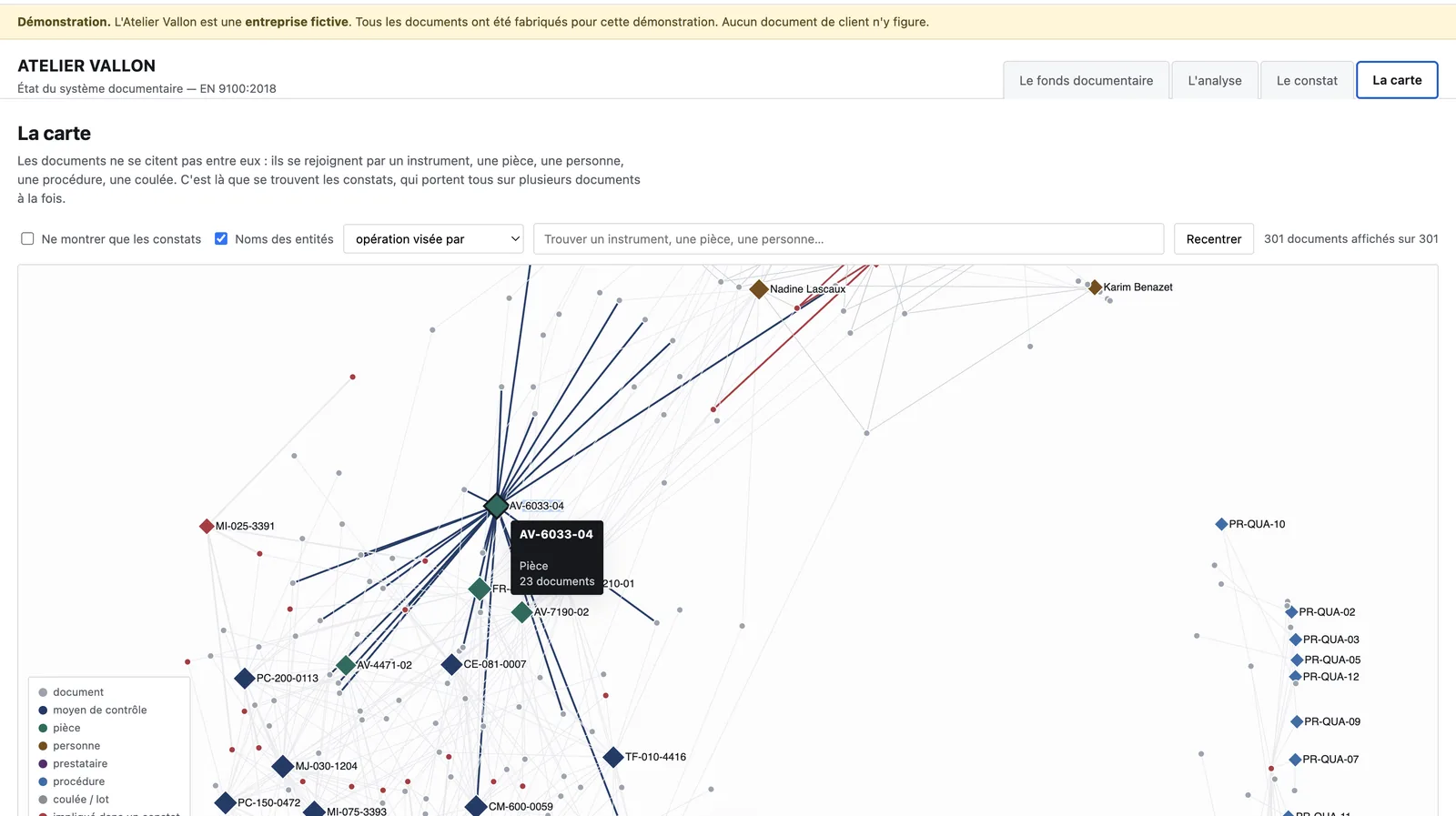
We work in French as well as English. The screen above is the French interface; engagements, sessions and written work are delivered in either language.
Try it yourself
The Atelier Vallon demonstration is open: the same system, on the fictional corpus, with nothing to install and no sign-up. It is in French.
Beyond legal
The same architecture, pointed at any body of knowledge.
Litigation is the hardest version of the problem: high volume, high stakes, and a privilege requirement that rules out the cloud entirely. Solve it there and it transfers. The same system runs over operations, research, compliance or engineering records - a private second brain that acts, on your hardware.
A hierarchy of knowledge
Structured · Searchable · Yours
Every document, note and decision organised into a structure you define, with semantic search across all of it. Ask anything and it answers from the record rather than from a guess.
AI as orchestrator, not custodian
Local-first · Zero cloud exposure
The AI connects to your knowledge base and instructs agents to act on it. It orchestrates; it never holds. Your data stays on your hardware at every step.
Self-improving by design
Each session sharpens the system
Every question, correction and refinement feeds back in. The structure grows more accurate and the retrieval improves, without anything leaving your environment.
Two projects already running on the same principle:
Bomza: SANS 10400
Building regulations · South Africa
Verification of building plans against the South African National Building Regulations. Documents checked against a published standard, with every finding traced back to the clause it comes from.
EntityVault
Entity management · Consent-based sharing
Tokenised storage and consent-based collaboration, so records can be shared between parties without exposing the underlying data to any of them.
Where it fits
Pythia suits anything legal, regulatory or commercially sensitive that cannot be sent to a cloud service or a US-hosted model: privileged material, regulated records, contractual or export-controlled data. The constraint is the same wherever it comes from: the documents cannot leave. Everything runs on hardware you control.
Not a law firm?
The same system, on the same hardware, doing the work an accounts department or a machine shop already does by hand. There is a page written that way round.
Engagement
Three stages, each one a decision point rather than a commitment to the next.
Diagnostic
€600 per day
One to two days for a simple project; up to two weeks for a larger build, such as a whole set of chambers. We review your real documents and workflows and tell you exactly what Pythia can do for your practice. Credited in full against the build if you proceed.
The build
From €7,000
Larger builds, such as a whole set of chambers, are priced well above this. The diagnostic fee is credited against the final build. Custom build, scoped after the diagnostic. Excludes hardware. The figure is an estimate based on builds we have already delivered, not a quote. Typically four to eight weeks from sign-off to a system running on your premises.
Ongoing
10–20% p.a.
Of the build price, with a minimum of €200/month. Agreed during the project, not fixed up front. Covers ingestion of new matter files, system maintenance, and keeping Pythia current as your work evolves.
Hardware, bought by you and specified by us
- EntryApple Mac mini, from about €2,000
- StandardNVIDIA DGX Spark, about €4,800
- Mac alternativeApple Mac Studio, from about €3,000; the memory needed for larger document sets costs considerably more
Indicative retail prices including VAT, checked September 2026. We specify the configuration after the diagnostic.
On the name
The Pythia was the Oracle at Delphi - the one you consulted when you needed an answer from everything that had been heard.
Pythia was the title given to the high priestess of the Temple of Apollo at Delphi, who served as its oracle. The name derives from Python, the serpent Apollo slew at Delphi. To put a question to the Pythia was not to ask for a guess - it was to receive the distilled answer from everything the oracle had witnessed and absorbed. That is the model: every document, read; every question, answered from the record itself.
Ready to see it in your practice?
Book a thirty-minute conversation. We'll walk through your documents and tell you what's possible.